

 Legality and Trust
Juvenile Justice. #Introspections: first national survey of youth in IPM presented at the Chamber. Family, freedom and loyalty top the list.
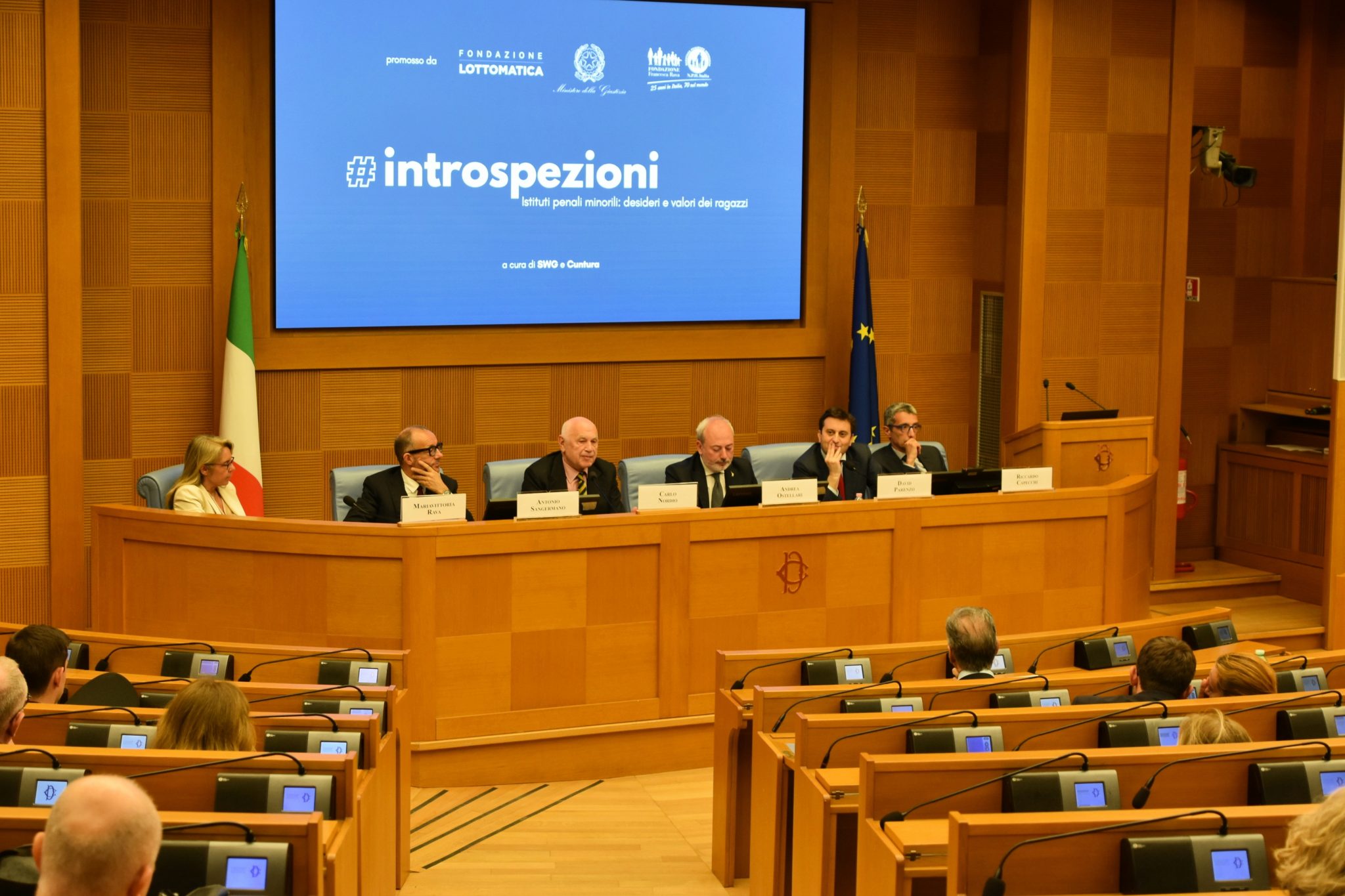
On May 21, 2026, at the New Hall of the Parliamentary Groups of the Chamber of Deputies,“Introspections – Juvenile Penal Institutions: desires and values of juveniles,” the first national survey conducted on the entire population in the 18 Juvenile Penal Institutes (IPM), was presented. The project was promoted by the Ministry of Justice, together with Lottomatica Foundation and Francesca Rava – NPH Italia ETS Foundation, and was curated by research institutes SWG and Cuntura.
Speakers at the event, in addition to Justice Minister Carlo Nordio, included Undersecretary Andrea Ostellari, the head of the Department of Juvenile and Community Justice, Antonio Sangermano, Riccardo Capecchi, president of Lottomatica Founation, Mariavittoria Rava, president of Rava Foundation, the president of the research firm SWG, Adrio Maria De Carolis, the director of Cuntura, Domenico Petrolo, and SWG senior researcher, Alessandro Scalcon. The event was moderated by David Parenzo, journalist for La7 and Radio 24.
The first census research on Italian IPMs
#Introspections is the first census-based survey ever conducted in Italy on the inmate population in national IPMs. The survey took place between December 9, 2025, and January 20, 2026, and involved all 18 institutions nationwide, involving more than two-thirds of the total inmate population. To ensure everyone’s participation, the questionnaire was translated into 13 languages, reflecting the heterogeneous composition of a population in which young foreigners represent a significant share.
An unexpected portrait: values, bonds and plans for the future
The results challenge many clichés. Ninety-two percent of respondents put family in first place, experienced-as SWG senior researcher Alessandro Scalcon explained-as “the safe space of re-appropriation of freedom”: that family that “re-educates to freedom and normality.” This is followed by freedom (66 percent), loyalty (47 percent) and love. “Loyalty and sincerity as relational exchange currencies. To be strong, not powerful,” the research reads. Cunning, power and ambition, on the other hand, rank at the bottom: they are not, as one might assume, the values that drive these young people’s worldview. Forty-eight percent describe themselves as calm; only 17 percent as angry. They talk about forgiveness and respect; they think of strong moral relationships in which people apologize and do not betray their peers. The vast majority say they have a concrete goal for the future and are determined to achieve it. The plans described speak of work, family, education, redemption-a desire for normalcy and stability that runs through almost all of the stories collected. Almost all say they are willing to engage in socially useful initiatives, with a clear preference for proximity actions: helping other young people who have made the same mistakes, or people in fragile situations.
The role of Lottomatica Foundation: listening as an act of civic responsibility
For Lottomatica Foundation, supporting #Introspections means recognizing that listening to those on the margins is an act of civic responsibility before even social responsibility.
The project is part of the Foundation’s commitment to the most vulnerable segments of society, with an approach that prioritizes knowledge as the basis for effective intervention. Giving a voice to girls and boys detained in Italian IPMs-through a rigorous tool that respects their dignity-produces data that is useful not only for research, but also for the construction of reintegration policies and programs that are more in line with real needs. The event at the Chamber of Deputies brought the results of this research to the heart of the institutional debate i, confirming the value of a model of collaboration between foundations, institutions and the scientific world. As President Riccardo Capecchi stressed, “Listening to their voice – ‘ask the boy’ – and understanding their needs is an essential element in structuring a path that is authentically rehabilitative.”
The event at the Chamber of Deputies brought the results of this research to the heart of the institutional debate, confirming the value of a model of collaboration between foundations, institutions and the scientific world.