

 Legality and Trust
Rome the discussion on the future of the Middle East with Pier Luigi Petrillo and Cecilia Sala
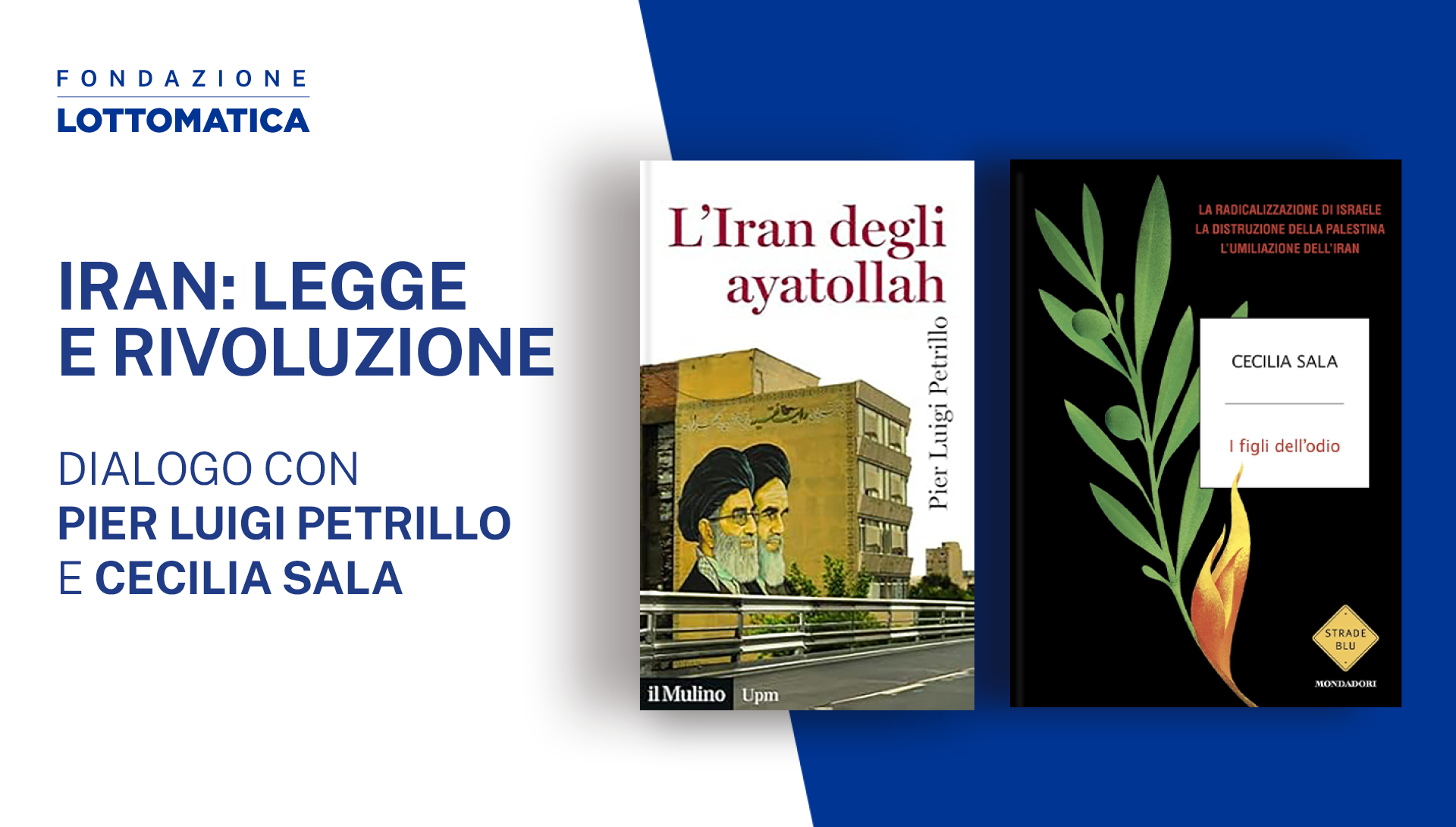
Iran: law and revolution. In Rome, discussion on the future of the Middle East with Pier Luigi Petrillo and Cecilia Sala
Yesterday, March 10, the meeting “Iran: law and revolution” was held at the Lottomatica Foundation headquarters in Rome, a round table dedicated to the analysis of the political and geopolitical dynamics affecting Iran and, more generally, the balance in the Middle East.
The appointment was inspired by the presentation of two recent publications: “L’Iran degli ayatollah” (Iran of the Ayatollahs) by Pier Luigi Petrillo and Cecilia Sala‘s book I figli dell’odio (The Children of Hate), providing an opportunity for a discussion on an increasingly complex and evolving international scenario.
Indeed, the Middle East has returned to the center of international attention in recent months, with developments involving various regional and global players that are helping to redefine the geopolitical balance in the area. The picture has been further complicated in recent weeks, with the escalation culminating in the outbreak of a new conflict following the attack led by Israeli-American forces and Iran’s subsequent response, fueling fears of further regional destabilization.
In this context, the meeting was a time for reflection and insight into Iran’s role and the political and social transformations sweeping the region.
Iran’s role in the geopolitical scenario
Some of the main issues related to contemporary Iran were addressed during the discussion: the evolution of the Islamic Republic’s political system, the relationship between institutions and religious authority, the transformations of Iranian society, and the country’s role in the delicate geopolitical balances in the Middle East.
The two volumes presented offer complementary perspectives on these issues. The book “L’Iran degli ayatollahs” by Pier Luigi Petrillo, analyzes the functioning of the Islamic Republic’s institutions and the dynamics of the Iranian political system since the 1979 revolution. “I figli dell’odio”, by Cecilia Sala, on the other hand, offers a report on the contemporary Middle East through the stories and experiences of new generations who grew up within the region’s conflicts.
The analysis of the two perspectives was followed by a moment of discussion on the future of Iran and scenarios for the reorganization of the entire Middle East region after the conflict. The discussion also touched on the role of Europe and key international players, as well as the possible consequences of geopolitical tensions on global economic balances and energy markets.
“In my latest book I talk about a post-Islamic revolution, in which religion is a fetish, something behind which politics hides choices that have nothing to do with religion,” Pier Luigi Petrillo ‘s words. The election as Supreme Guide of Khamenei’s second son-in-law seems to confirm this. He is not a spiritual leader, he does not have the characteristics to assume that office, however, he was appointed anyway “.
With the choice of Mojtaba Khamenei as the new supreme leader, “the signal that the regime men want to give is really that nothing changes,” said Cecilia Sala. ” It is a victory for the Pasdaran of the military wing of the regime, to whom this new supreme leader Khamenei-Young has been very close for years.
The meeting was attended by representatives from the world of institutions, journalism and research, contributing to an articulate discussion on the region’s prospects and the dynamics that are redefining international balances.
“We thought that we could seize the opportunities that two very interesting books like those by Pier Luigi Petrillo and Cecilia Sala gave us ,” said Riccardo Capecchi, president of Lottomatica Foundation. Putting them together has made it possible to address a very topical issue. The possibility of addressing and reasoning about the current opposition needs understanding, and those who know things can help give us important stimuli.” .


