

 Health and Inclusion
Lottomatica Foundation presents FAST agenda to counter demographic winter
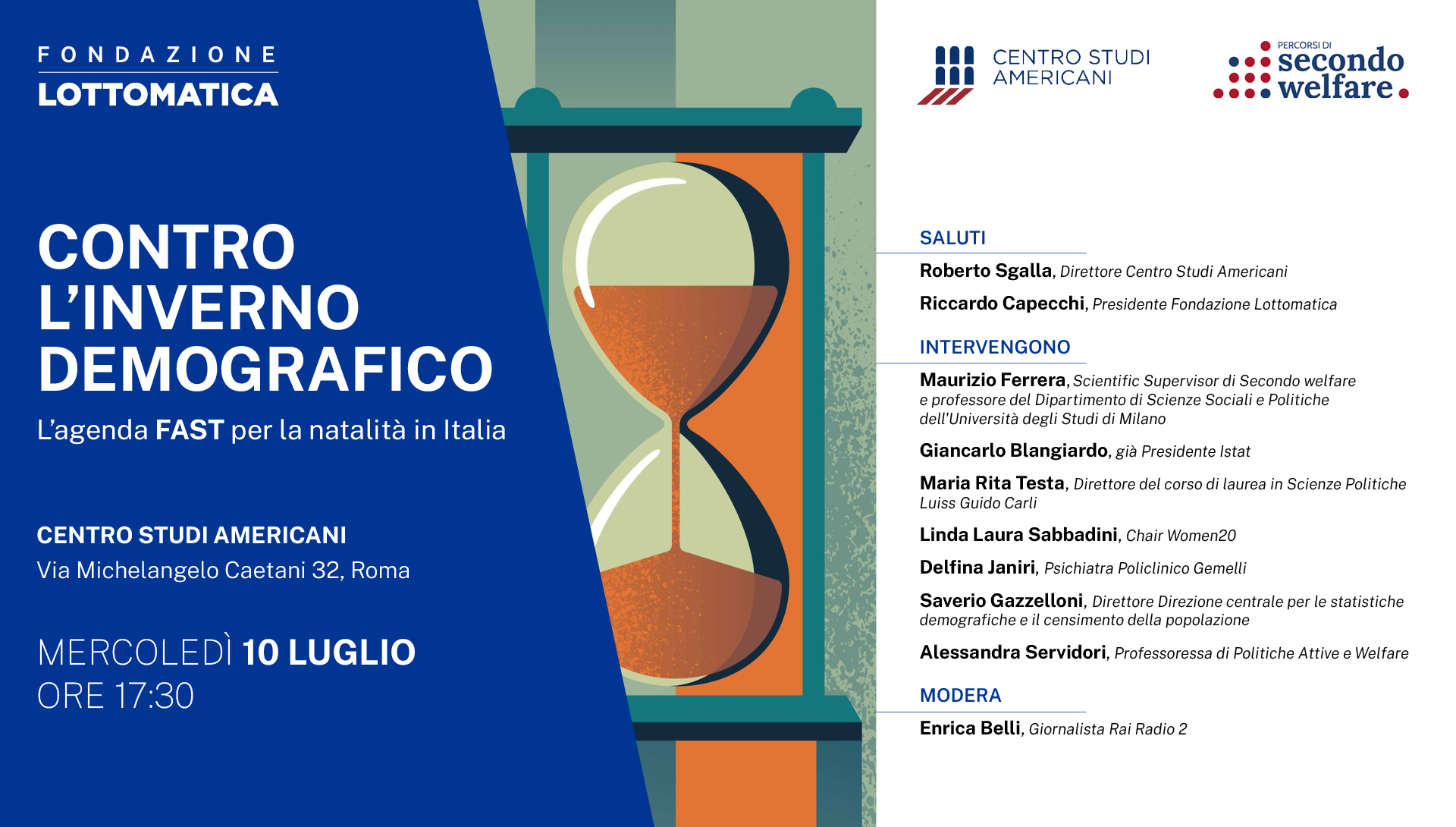
Fighting the “demographic winter” through concrete, immediate and family-friendly solutions. This was the topic at the center of the debate at the presentation of the agenda FAST for the birthrate in Italy, the first report sponsored by the Lottomatica Foundation on the demographic emergency and strategies to counter it, produced by the research team of Percorsi di secondo welfare.
The event was held on Wednesday, July 10 at 5:30 p.m. at the Center for American Studies in Rome, with opening remarks by Riccardo Capecchi, president of the Lottomatica Foundation, and Roberto Sgalla, director of the Center for American Studies. Speakers at the debate included Maurizio Ferrera, Scientific Supervisor of Second Welfare and editor of the report, as well as professor at the Department of Social and Political Sciences, University of Milan; Giancarlo Blangiardo, former ISTAT President; Maria Rita Testa, Director of the Luiss Guido Carli Political Science degree program; Linda Laura Sabbadini, Chair Women20; Delfina Janiri, Psychiatrist at Policlinico Gemelli; Saverio Gazzelloni, Director of the Central Directorate for Demographic Statistics and Population Census; Alessandra Servidori, Professor of Active Policies and Welfare. The event was moderated by Enrica Belli, Rai Radio 2 Journalist.
The title of the report,“Famiglia, Asili, Servizi, Tempi” recalls the four guidelines guiding a concrete plan of action to reverse the course of under-natality in Italy, focusing as effectively and quickly as possible on key aspects such as daycare centers , family-friendly care, improved services and a different time management that includes work-life balance. The acronym FAST emphasizes the urgency with which action is needed to avert the negative impacts of this phenomenon on the country’s productivity, economy, and sustainability.
“The FAST agenda provides a vision for overcoming the problem,” said Riccardo Capecchi, president of the Lottomatica Foundation, “We need to deal with ensuring that families have opportunities to develop fertility and the family itself. So more kindergartens, more income to families who have children, and more school infrastructure.”
“Our demographic structure is changing rapidly and will make our social and economic model unsustainable in the medium and long term,” recalled Maurizio Ferrera, scientific supervisor of Secondo Welfare. “On these policies we spend about 20 billion a year less than other countries. Our political class is very focused on the retired category, and has no courage or foresight to recalibrate spending on families and children.”
Finally, the agenda FAST proposal plan suggests a consideration of the next steps to be taken in the immediate future regarding governance, such as the need to establish a Commission of Inquiry on demographic trends that could be the first step toward the creation of a permanent Observatory on the phenomenon.


